Category

Research

The Cornel Wilde boys of north Bondi

Little remembered today, Hollywood actor Cornel Wilde inspired a hairstyle first adopted by north Bondi surfers in the late 1940s before being taken up across Australia by fashion-conscious young men.

In mid-century parlance, Wilde was ‘husky’; a cross between hunky and buff. He became famous for his bare-chested action roles, but one of his two breakthrough performances in 1945 was as Aladdin in the cheesy orientalist spectacular, A Thousand and One Nights.

A New York critic panned A Thousand and One Nights as a ‘strictly bobby socks version of Aladdin’. Wilde looked ridiculous in an ‘Oriental zoot suit’, he wrote.The young men of Bondi thought otherwise. They seem to have revelled in Wilde’s tan-and-pink shoulder-padded shirt with the sleeves rolled high over bulging biceps, his blue trousers pegged at the ankles and falling in voluminous pleats from the waist.
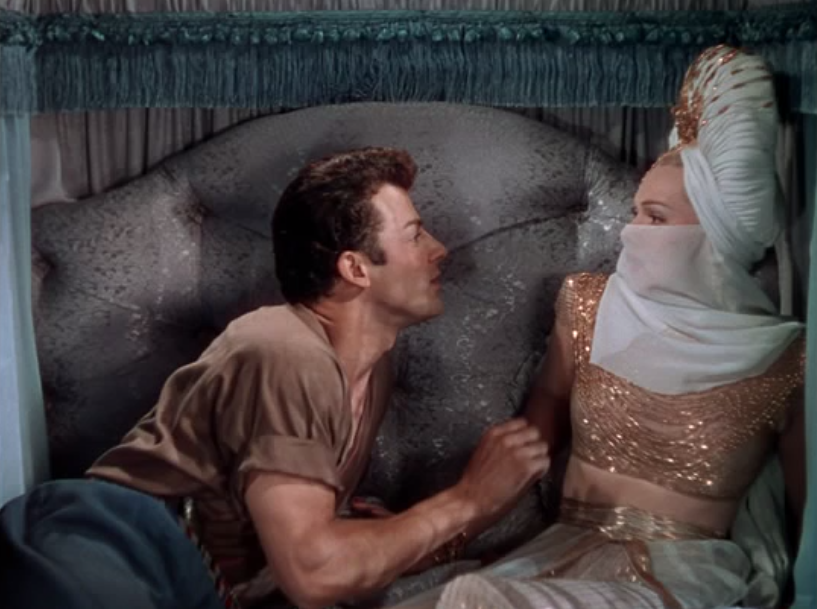
A screenshot of Wilde as a ‘bobby sox Aladdin’ in A Thousand and One Nights (1945)

The surfers of Bondi were even more appreciative of Wilde’s hair. He had a pile of curls on top, the back fuller than most Australian men wore at the time, and carefully groomed side-levers finishing just above his cheekbones.

According to young Bondi man Arthur Rea, he and other fans of the Wilde cut were not necessarily enthusiasts of the actor’s films. ‘Most of us go to his pictures, but only to look at his hairstyle’, he told the Sydney Sun in 1946.

The Sun’s interview with Rea was a sign of the media fascination with youth fashion that would explode along with postwar consumerism in the next decades. The publicity given to the Wilde style meant that it spread well beyond fashion-forward Bondi. Perth headlines in 1951 blared ‘You Too Can Be Bodgie or Cornel’ – while in 1954, another paper reported sightings of an Aboriginal stockman at a Darwin cinema sporting a Wilde haircut along with swank cowboy wear.
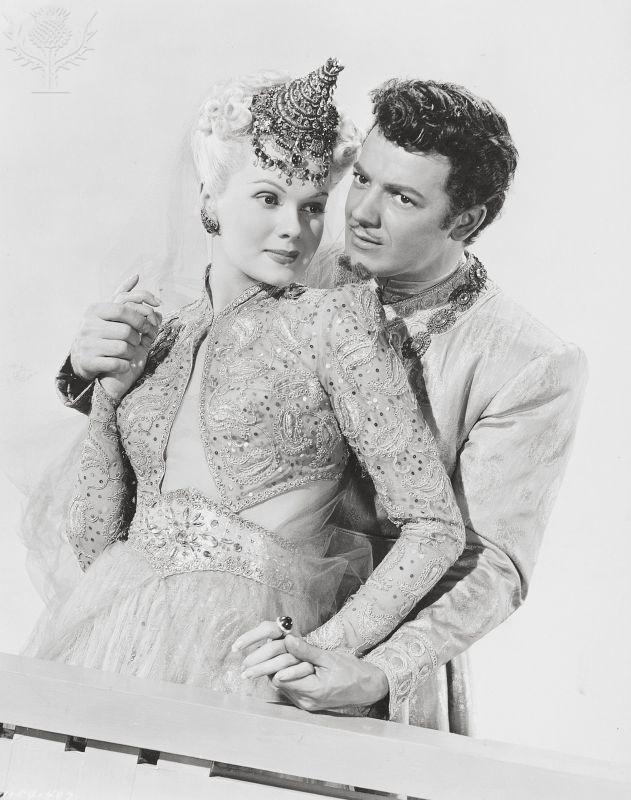
Promotional image of Wilde and co-star Adele Jergens in A Thousand and One Nights
COLUMBIA PICTURES / Album / Universal Images Group
Rights Managed / For Education Use Only

Share your knowledge

Do you know anyone who sported a Cornel Wilde cut or similar style in 1940s or ‘50s Australia? If you have memories or old photographs you want to share, get in touch or head to our Instagram page #coattalesofhistory

Tags: Historical Bondi fashion, Cornel Wilde

References

Anonymous, ‘Girls Fall For the “Cornel Wilde” Style’, Sun (Sydney), 24 November 1946, 11. 

Anonymous, ‘You Too Can Be Bodgie or Cornel: New Hair Vogue For Men’, Mirror (Perth), 19 May 1951, 10.

Bosley Crowther, ‘The Screen: A Thousand and One Nights Costume Show, With Cornel Wilde, Opens at the Criterion’,New York Times,12 July1945.

Eric Joliffee, ‘Hopalong, He Bin Proper Hero There’, Sun-Herald (Sydney), 21 November 1954, 50.

Working with material sources

Research

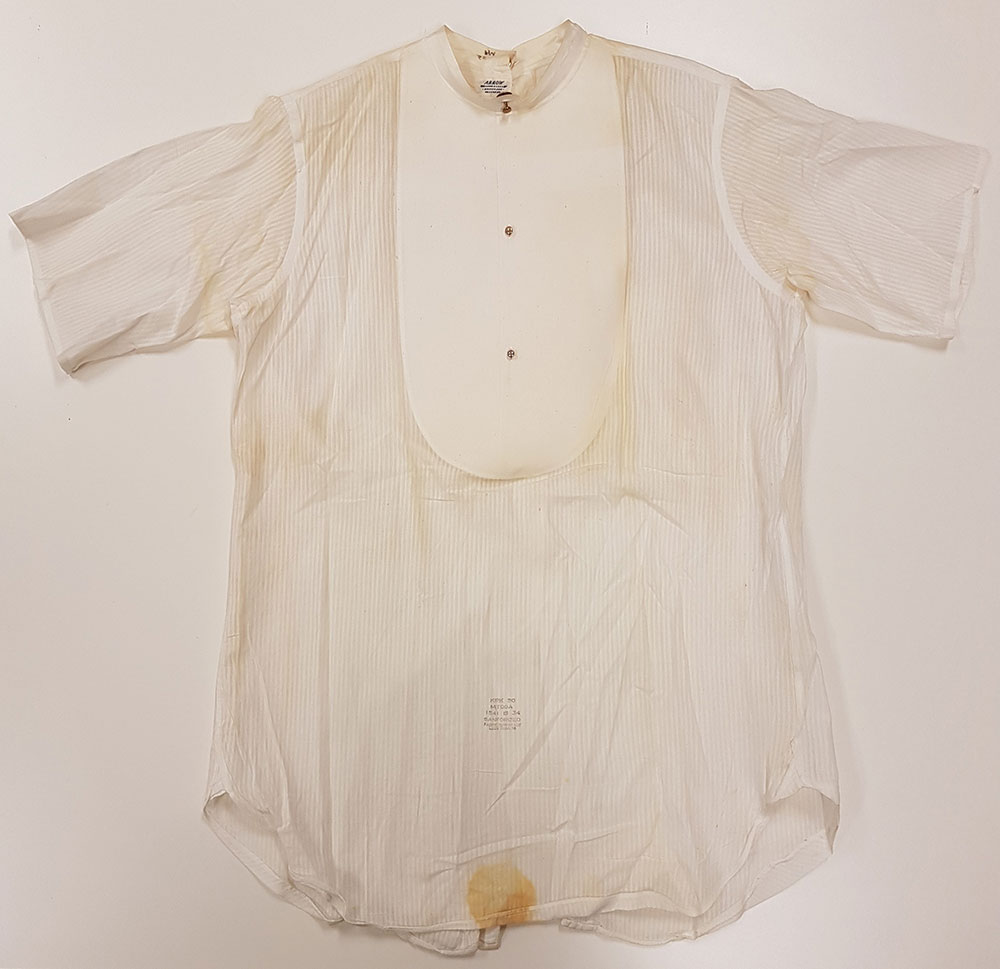
In removing the white shirt from its hanging rack, two things become apparent: the sleeves, once long, have been cut then hand-stitched to finish above the elbow; and now-yellowed sweat stains bloom under the arms. I’m looking at a stiff-fronted dress shirt worn by Percy Grainger, composer, arranger and pianist. When worn under his black tailcoat neither of these would be visible. But in looking at the shirt, one of scores in the fascinating collection of the Grainger Museum, I wonder two things: were the sleeves shortened to enhance movement in his arms during performance, and just how much did he sweat playing in concert halls before his adoring audiences?

Faded, frayed, stained or torn clothes might embarrass us when we wear them (or they might instead be deliberately stressed for effect), but for the curator and historian these flaws are marks from the past, an intimate record of wear. This is one of the reasons why clothes worn, and loved, are important to this project. We want to better understand not only why clothes were chosen at a moment in time, but how they were worn, how they felt on the body and the memories that are bundled up in them.

When clothing enters a museum collection, the inside is examined just as closely as the outside. This seems almost counter-intuitive because we’ll never display clothing inside-out – although I think an exhibition like this would surprise and delight many people.

But taking a ‘slow approach to seeing’ can reveal all kinds of hints about a garment’s maker, its wearer, and its life history. I’ve examined clothes heavily mended and cleverly adjusted, with these barely detectable on the visible surfaces; stained with red wine or make up; with stitching strained, elastic stretched, hems frayed or raw edges unfinished. Donors are sometimes hesitant to gift clothing to museums in less-than-perfect condition, but blemishes have much to tell us, especially if we take up Ingrid Mida and Alexandra Kim’s challenge to be dress detectives.

Perhaps they were worn over long periods of time or by multiple wearers – recycling clothing is nothing new. Maybe they were a party favourite or considered good under the hot sun. Their wearer might have put on weight or been too busy to shorten hems too long. They might have been made quickly in a Bangladeshi factory, or slowly and with love.

In carefully looking at the surfaces of clothing we can begin to better see how fabric holds these markings and memories of the bodies it clothed – and we can start to ‘read’ their material qualities. So each time Melissa and I head into museum collection stores, we’ll be looking out for these messages from the past and alert to what they might tell us.

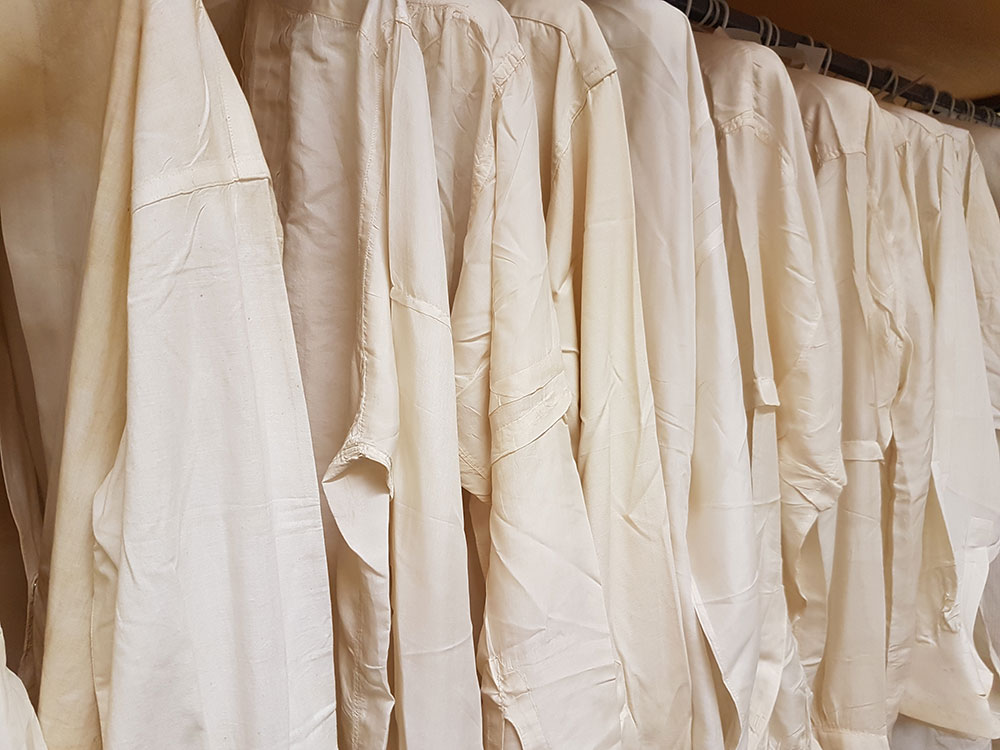
‘White dress shirts worn by Percy Grainger’, Grainger Museum Collection, University of Melbourne. Courtesy Grainger Museum.

‘Shirt worn by Percy Grainger’, made by Arrow, U.S.A., 04.6894, Grainger Museum Collection, University of Melbourne. Courtesy Grainger Museum

References

Ingrid Mida and Alexandra Kim, The Dress Detective: A Practical Guide to Object-Based Research in Fashion (London: Bloomsbury, 2015).